
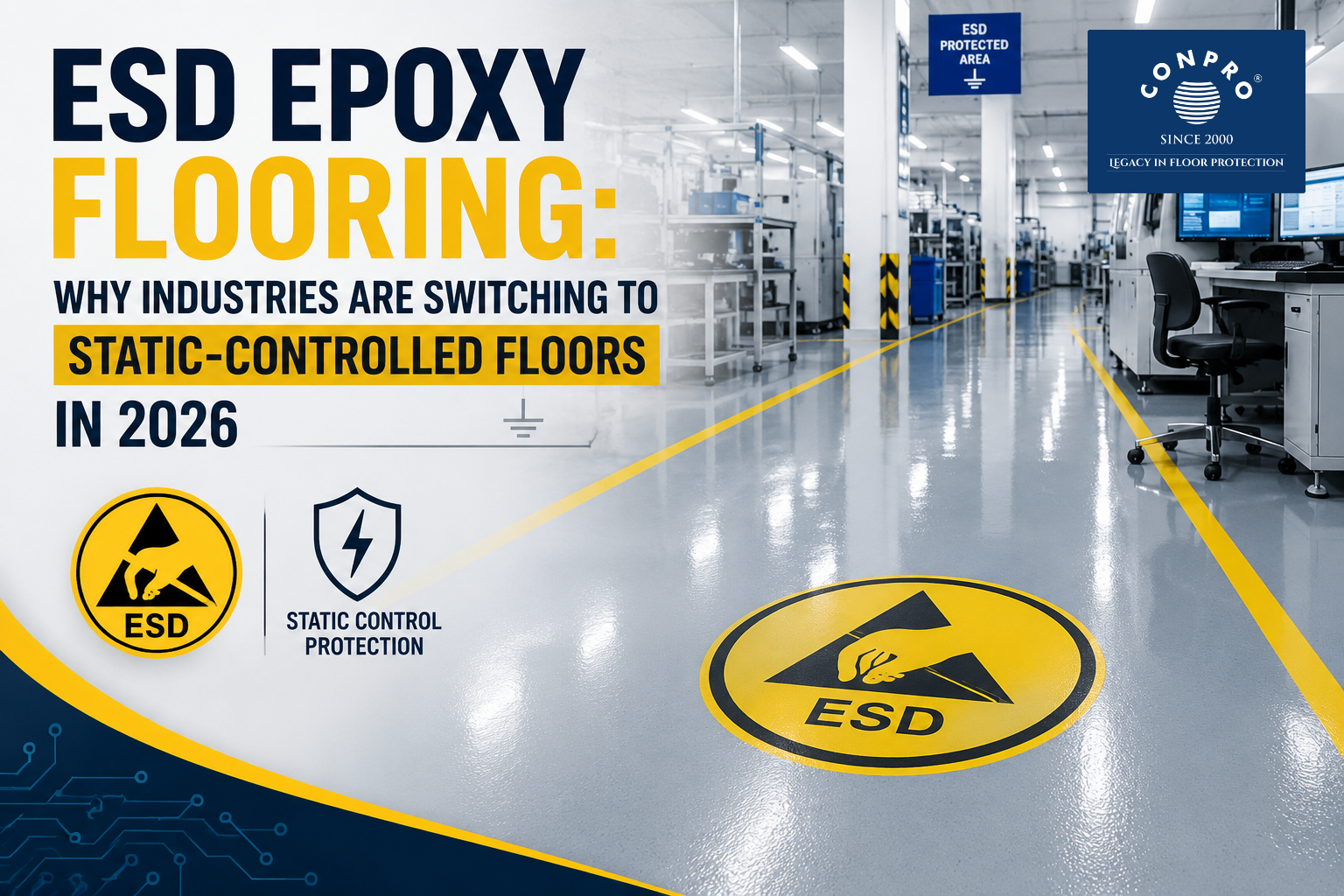
Industrial flooring is no longer selected only for strength and durability. With the development of technology, including electronics, automation, EV manufacturing, pharmaceuticals, and precise engineering, it becomes imperative that the floor material used be able to control ESD in addition to providing wear resistance.
The ESD Epoxy Flooring provided by Conpro Chemicals offers such functionality by offering the strength of epoxy along with static-dissipating or conductive features. This flooring is expected to become an important aspect in 2026 for plants where static electricity could affect the products, equipment, or even the safety of workers.
Understanding the Need for Static-Controlled Flooring
The static charge is produced naturally through activities like walking, movement of machinery, and interaction of various objects. In an ordinary setting, there is no cause for worry about this problem. But in cases where the process involves an electronic manufacturing industry or handling of flammable substances, the static discharge can be problematic.
A static charge may:
- Damage sensitive electronic components
- Affect testing and production processes
- Cause latent defects in electronic products
- Interfere with sensitive equipment
- Create ignition risks in specific industrial environments
For these applications, controlling static electricity needs to be part of the facility’s overall design—not an afterthought.
Why Are Industries Moving Towards ESD Flooring?
The shift towards static-controlled flooring is being driven by changing industrial requirements.
1. Protection of Sensitive Electronics
Modern manufacturing involves components that can be highly sensitive to electrostatic discharge.
ESD flooring helps control static buildup in areas handling:
- Semiconductors
- PCBs and electronic assemblies
- Sensors and microprocessors
- Electronic testing equipment
- Precision components
This can help reduce the risk of ESD-related product damage and latent defects.
2. Growing EV & Battery Manufacturing
The rapid development of EV and battery manufacturing is creating more facilities where controlled production environments are important.
ESD flooring can be considered for areas involved in:
- Battery component manufacturing
- Electronic control systems
- Testing and assembly
- Precision equipment operations
The flooring specification should always be based on the actual process and electrical safety requirements of the facility.
3. Better Control in Sensitive Work Areas
Uncontrolled static electricity can interfere with sensitive manufacturing processes and equipment.
A properly grounded ESD flooring system helps:
- Reduce static charge accumulation
- Provide a controlled discharge path
- Support a more stable production environment
- Protect static-sensitive operations
4. Durability for Industrial Conditions
Industrial flooring must handle more than foot traffic. ESD epoxy systems can be designed to withstand demanding operating conditions, depending on the resin system selected.
Key advantages include:
- High mechanical durability
- Resistance to regular industrial traffic
- Seamless surface
- Reduced joints and gaps
- Easy cleaning and maintenance
- Resistance to selected chemicals
Where Is ESD Epoxy Flooring Used?
ESD epoxy flooring is suitable for applications where electrostatic control is an important operational requirement:
- Electronics and semiconductor manufacturing
- PCB assembly and testing facilities
- EV and battery manufacturing
- Pharmaceutical production areas
- Laboratories and research facilities
- Medical equipment manufacturing
- Precision engineering units
- Static-sensitive assembly areas
What Should Industries Check Before Installation?
Choosing an ESD floor should begin with the facility’s actual requirements.
Consider:
- Required electrical resistance range
- Type of manufacturing process
- Existing grounding arrangement
- Substrate condition and moisture levels
- Expected traffic and load
- Chemical exposure
- Cleaning and maintenance requirements
- Applicable industry standards and testing procedures
Professional assessment before installation helps ensure that the flooring system matches the operating environment.
Why ESD Flooring Matters in 2026?
The industrial sector is moving towards smarter, automated, and electronics-intensive production. As this transformation continues, static control is becoming an important part of facility planning. ESD Epoxy Flooring by Conpro Chemicals offers industries a practical combination of:
- Electrostatic control
- Industrial durability
- Seamless protection
- Easy maintenance
- A cleaner production environment
For new facilities as well as industrial floor upgrades, evaluating ESD requirements at the design stage can help businesses build a more controlled and future-ready workplace.
Best ESD Epoxy Flooring – Conpro Chemicals
ESD flooring is not simply a flooring upgrade; it is part of a facility’s overall static-control strategy. When properly specified, grounded, installed, and tested, ESD Epoxy Flooring can help industries protect sensitive operations while maintaining the durability expected from industrial epoxy flooring. As manufacturing becomes increasingly technology-driven in 2026, static-controlled flooring is set to become an increasingly important consideration for modern industrial facilities.
Frequently Asked Questions:
1. Where is ESD Epoxy Flooring commonly used?
It is commonly used in electronics, semiconductor, EV and battery manufacturing, pharmaceutical facilities, laboratories, and precision engineering units.
2. How is ESD epoxy flooring different from regular epoxy flooring?
Regular epoxy mainly provides durability and surface protection, while ESD epoxy is specifically designed to provide controlled electrostatic dissipation through a properly grounded flooring system.
3. Does ESD Epoxy Flooring require regular maintenance?
Yes. Routine cleaning and periodic inspection help maintain the floor’s appearance, performance, and ESD properties over its service life.